Food is Medicine
Article by Holly Prestidge, MCV Foundation
Photos by Daniel Sangjib Min, MCV Foundation
Video by Tyler Trumbo, MCV Foundation
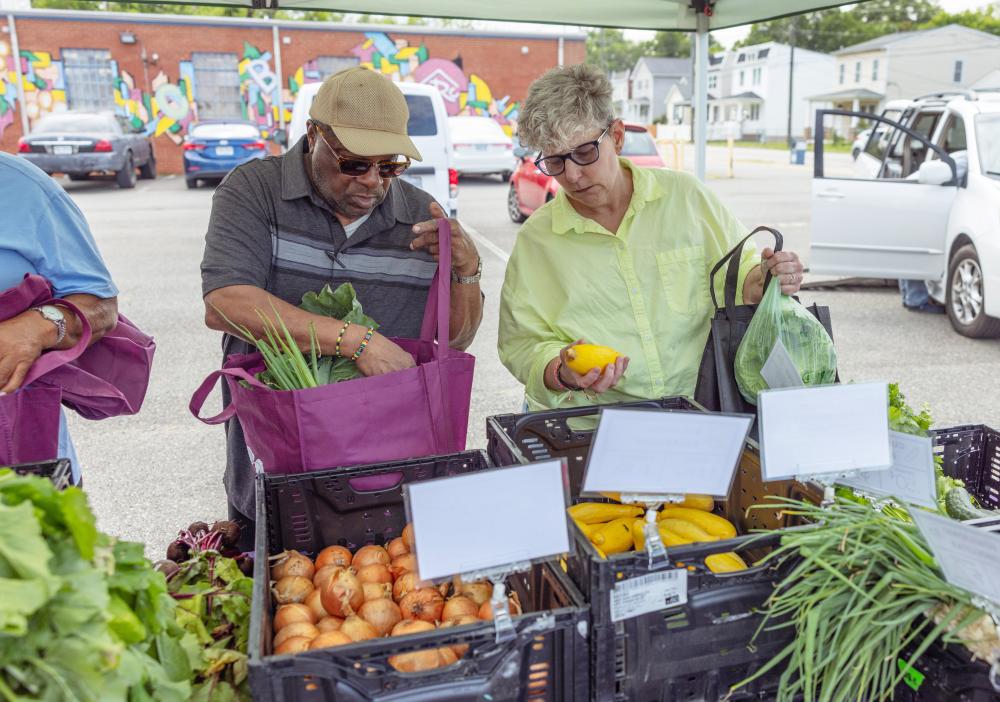
Melissa Earley perused the colorful assortment of fresh fruits and vegetables at the Shalom Farms Mobile Market in late spring, eagerly soaking in the friendly unsolicited advice from the man in line ahead of her about how to choose the best yellow squash.
The market, located at the Neighborhood Resource Center in Richmond’s Fulton Hill, displayed bunches of leafy greens and hearty root veggies, and Earley was downright giddy to learn that fresh brown eggs and plump berries filled the coolers just beyond the table.
Earley is one of an estimated 18 million cancer survivors living in the U.S. In October 2023, she was diagnosed with breast cancer, and by the end of that year underwent a double mastectomy at VCU Massey Comprehensive Cancer Center.
Earley watched her mother die from breast cancer in 2006. She elected the double mastectomy, she said, because she wanted to live.
The toll, however, was steep. The physical changes to her body were shocking. Coping with a dizzying three months from diagnosis to surgery and the start of recovery was difficult, but still she expected to return to work. Instead, after surgery, five months of chemotherapy were followed by four months of radiation and additional medication. She remains on active treatment and finds herself in the hospital periodically from complications.
Earley had to stop working. The financial hit further strained her already fatigued mind and body and exposed her to the grim realities of life for many cancer survivors. What money she had was, by necessity, allocated to other bills. Food — among the most basic of necessities — became a daily concern.
Don’t be ashamed — there’s no shame in healing. If you don’t have food, your body can’t heal.
Melissa Earley, patient, VCU Massey Comprehensive Cancer Center
About the same time Earley was rocked by her diagnosis, Massey had already begun researching food insecurity among its patient population. It surveyed more than 300 cancer patients who were being treated with either chemotherapy, radiation or both. Nearly 40% reported some level of not having enough to eat or knowing where their next meal would come from.
Those results led to discussions about interventions and, ultimately, an opportunity to secure a three-year, $940,000 grant from the McKesson Foundation to tackle food insecurity among Massey cancer survivors treated at Massey. A three-pronged approach was initiated in October 2024 that includes providing patients with emergency food boxes from Feed More plus connections to additional resources within the community; cooking and nutrition classes for patients and their caregivers; and permanent spaces within the VCU Health Adult Outpatient Pavilion where patients can access non-perishable as well as fresh seasonal food.
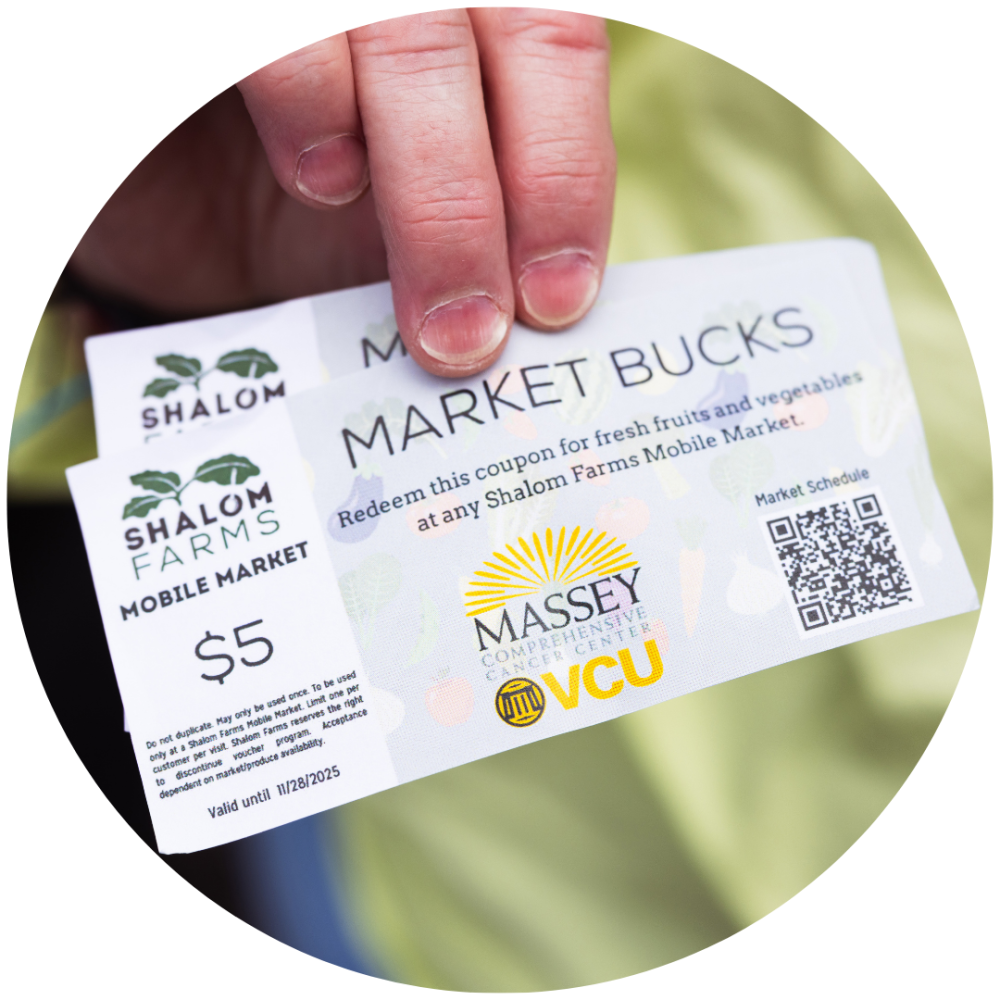
Patients are also given vouchers for food they can use at Shalom Farms and its mobile sites all over the area. That includes a location at the Adult Outpatient Pavilion, which continues a decades-old partnership between Massey’s Integrative Health program and local farm organizations to operate a fresh farm stand on the medical campus.
Back in Fulton Hill, Earley pulled a wad of those food vouchers from her pocket and handed a few to the Shalom Farms cashier. Her tote bag contained eggs, blueberries, lettuce, squash and more.
A small but nutritious bounty that meant so much more than the sum of its parts.
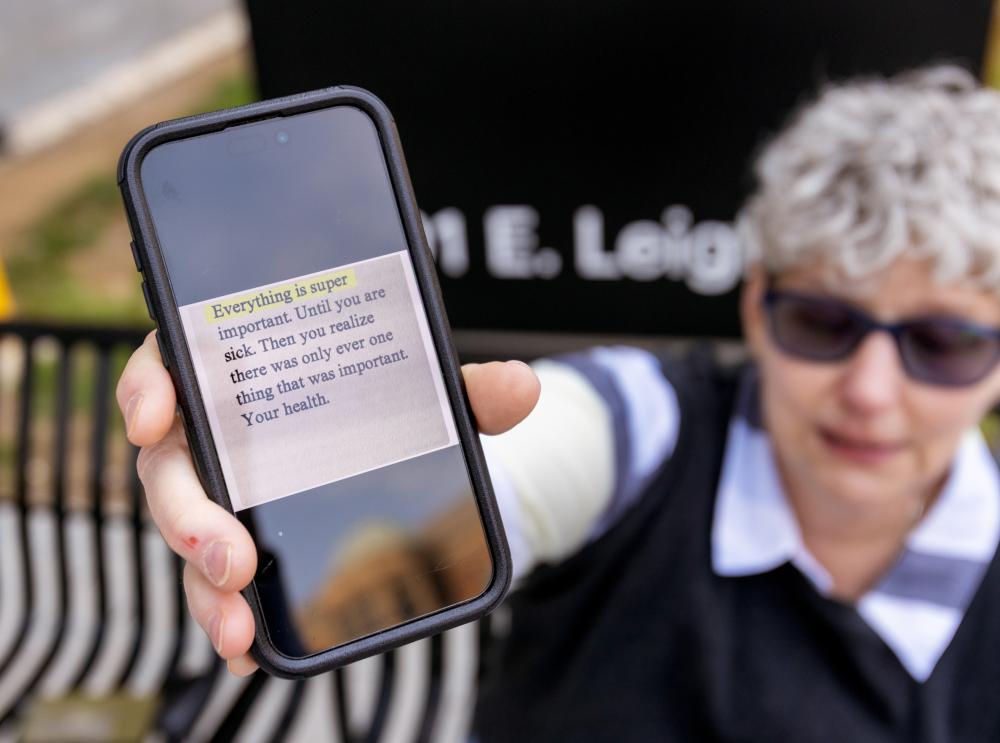
Reducing cancer’s burden
According to the U.S. Department of Agriculture, food insecurity impacts roughly 13.5% of the U.S. population. The National Institutes of Health reports that among people who have cancer, the numbers are much higher, ranging from 17% to as high as 55% among vulnerable populations who are already facing socioeconomic challenges.
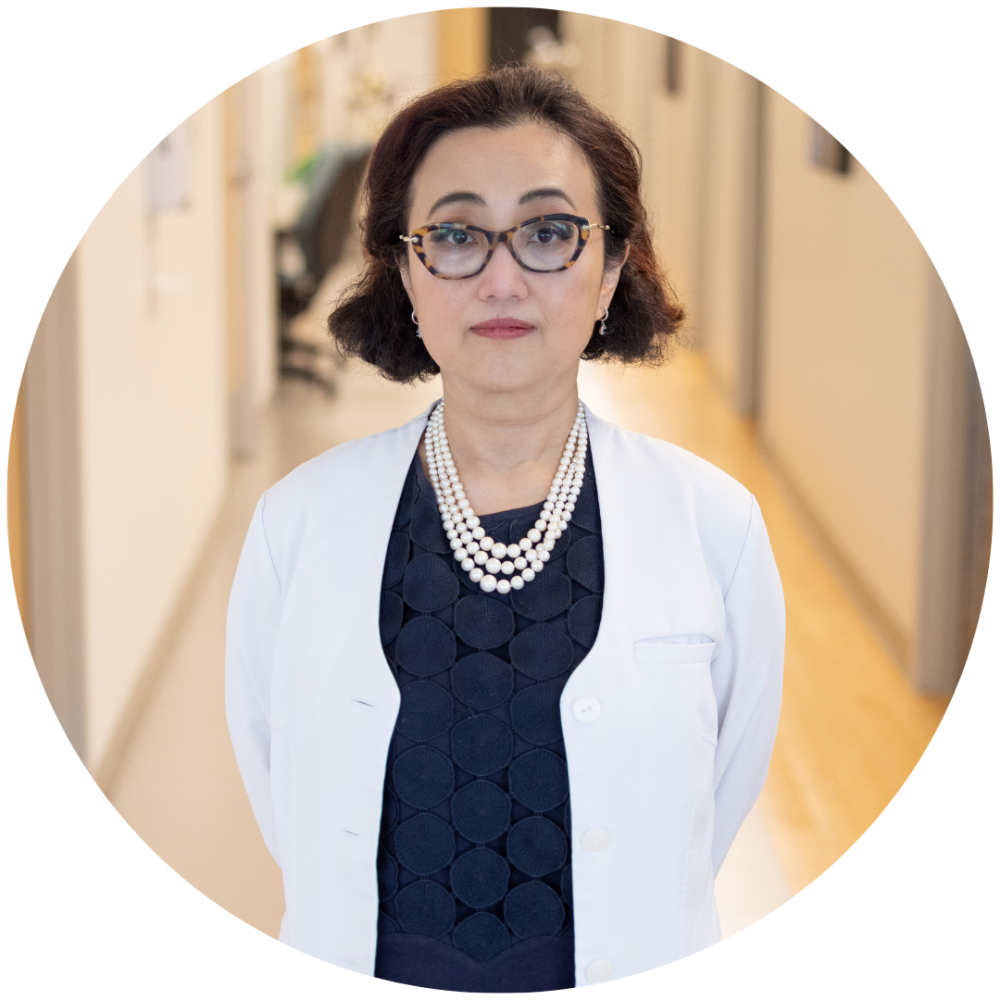
At 40%, Massey’s numbers were especially jarring to Susan Hong, M.D., who joined Massey in 2021 as director of its Cancer Survivorship Program.
“There’s a lot of financial toxicity associated with cancer,” Dr. Hong said. “Cancer has a massive impact on people’s lives and their ability to work. If you can’t eat or access food, that’s going to have a ripple effect. Poor nutrition affects your ability to tolerate treatments and that adds a huge layer of stress to your life.”
She added: “It’s so important not just to eat, but to eat well.”
She’d come from larger metropolitan cities and health systems where food insecurity resources were plentiful. Once she arrived at Massey, she began developing ways to address the issue.
Under her leadership, the comprehensive cancer center established a plan called Reducing Cancer’s Burden, from which came the three-pronged approach funded by McKesson called In Cancer Care, Food is Medicine.
Massey sees over 3,500 new cancer patients annually, Dr. Hong said.
Over the three years of the Food is Medicine grant, the goal is to reach nearly 3,000 patients with about 17,000 dry goods emergency food boxes, provide as much as $24,000 in food vouchers for fresh food, and educate hundreds of individuals through cooking and nutrition classes.
Being in an environment where you’re not alone, where there are resources we can provide to you, makes a big difference. We’re making sure we close the loop.
Susan Hong, M.D., director, Cancer Survivorship Program, VCU Massey Comprehensive Cancer Center
Additionally, patients are referred to local food pantries through the online Unite Us platform and are connected with long-term food resources to sustain them after they’ve completed treatment.
Dr. Hong emphasized research that shows healthy diets decrease readmittance rates to hospitals and help with chronic health conditions. The problem, she said, is access.
“There’s a lot of talk about how sick the country is overall,” she said, “but if we actually provided better nutrition and resources, that could make a huge difference because it shows the value and importance of sustainability in programs like Food is Medicine.”
Dr. Hong said when she began asking her patients about their needs, few opened up to her.
“Patients are generally not excited about sharing that information with us,” she said. “Nobody runs around saying, ‘I can’t afford to feed myself or my family,’ so I spent quite a bit of time trying to explain to patients that food insecurity happens to a lot of people.”
Thus far, Dr. Hong said, Food is Medicine has been exceedingly effective.
In its first year, Massey is already surpassing some of its goals. More than 300 boxes of emergency food have been distributed — four months earlier than expected.
Monthly and quarterly nutrition classes are registered to capacity, and participants routinely receive basic kitchen equipment and fresh food along with cooking demonstrations, easy-to-follow recipes and produce vouchers.
“Being in an environment where you’re not alone, where there are resources we can provide to you, makes a big difference,” Dr. Hong said. “We’re making sure we close the loop.”
McKesson Foundation President Melissa Thompson said her foundation stands on several strategic pillars that align with Massey’s goals.
"The McKesson Foundation is committed to advancing health outcomes for all," Thompson said. “Reducing the burden of cancer and providing food to those in crisis are core parts of our mission, and we are proud to be a part of the Food is Medicine program so that Massey's most vulnerable patients can worry less about basic necessities like access to healthy foods and focus more on their care."
Health, not Hunger
Cancer is heavy. Earley’s wit keeps things light.
The tumor that was removed from her breast in 2023 was roughly the size of a baseball, she said. She named it Wilson — referencing the moniker given to a volleyball by Tom Hanks’s character in the iconic movie “Castaway.”
She joked that she opted for the double mastectomy because being “lopsided” would cause her to walk in circles.
Cancer is a beast, and if you have it, you need everything possible to fight it. My body doesn’t crave chemo. My body doesn’t crave the pills I take. But my body craves food, and none of that other stuff matters if I don’t have something to eat.
Her life is so very different now.
“The day that I got my diagnosis, my life changed forever,” she said softly. “My head was spinning.”
Earley said over the last year and a half, she and her partner, Nona, have struggled to eat. Her treatments, which will continue for several years, sometimes wipe her out for days at a time or land her in the hospital. Job opportunities are slim.
“The ability to fill our fridge got harder and harder, and then it got to where we wouldn’t have food in the house,” Earley said. She has accepted meals from her church and other friends. Kind souls give them grocery store gift cards. Earley sheepishly admits she would sign up for public events if there was food involved, just so she could eat and maybe take leftovers home.
As someone who worked as a paramedic and a nurse, Earley said she was used to being the one to offer aid and solve problems.
“But I couldn’t figure this out,” she said.
During a treatment session at Massey last year, however, Earley was introduced to Food is Medicine when she was handed an emergency box of food.
“It was like magic,” she remembers thinking. “It was so heavy and when I opened it, there was enough food in there for like a week, maybe two.”
She also received vouchers to purchase fresh produce from Shalom Farms.
“They gave me what looked like Monopoly money, but it was real, it was spendable,” she said excitedly. “And that money would buy a lot, and they told me I could get more the next time.”
“I just cried,” she said.
The outreach underscores why she chose VCU Health and Massey for treatment.
“I knew I wanted my treatment at Massey,” she said. “Hands down, this is where I wanted to be.”
Superior medical treatment is only part of the reason for that gratitude.
“Here, I’m not just a patient; I’m Melissa, and I have relationships with people. People know what’s going on in my world when I come here,” she said. “You don’t find that everywhere, but that’s a big deal.”
Earley said Massey understands that healing the whole person is crucial.
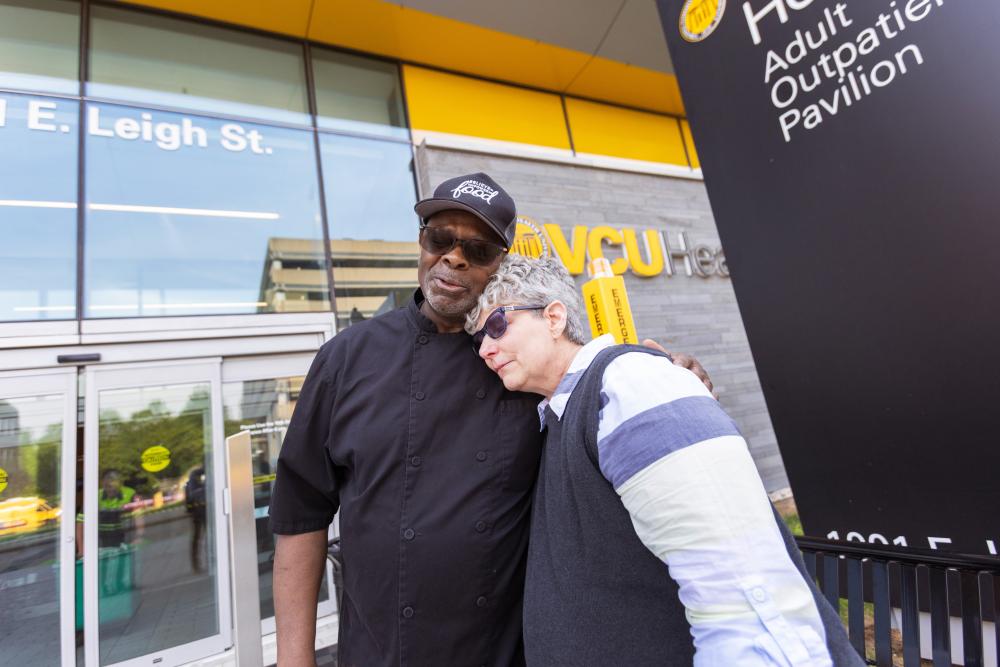
“Cancer is a beast, and if you have it, you need everything possible to fight it,” she said. “My body doesn’t crave chemo. My body doesn’t crave the pills I take. But my body craves food, and none of that other stuff matters if I don’t have something to eat.”
Battling cancer is hard. Asking for help shouldn’t be. “If you’re a person who gives others grace, allow yourself that same amount of grace and ask for help,” Earley said. “Pride doesn’t come with cancer. Don’t be ashamed — there’s no shame in healing. If you don’t have food, your body can’t heal.”
Despite what she’s been through, Earley is grateful — for her family, including her beloved fur babies Tobias Theodore Henry and Sebastian River Hunter; for her medical team and everyone she’s met through treatment at Massey and VCU Health; and for the donations from organizations like McKesson that allow her to focus on health and not hunger.
“I didn’t choose to be a cancer patient, but I chose to be a Massey patient,” she said. “This is not just a place to come for medical treatment, it’s a place to heal.”
If you would like to support the McKesson Food Insecurity Fund at VCU Massey Comprehensive Cancer Center, please contact Carissa Liverpool, Ed.D., the cancer center's associate director of development, by emailing liverpoolc@vcu.edu or calling 804-828-1450.
Teaching Patients Why Food is Medicine
VCU Massey Comprehensive Care Center offers nutrition and cooking classes to provide reliable, research-based nutritional information, kitchen tools and fresh food.