
Restoring Life: Giving Back at VCU Health Trauma Center
Written by Holly Prestidge | Photos by Daniel Sangjib Min | Video by Will Rummel
The brain’s talent for distraction in the face of danger is something Richmonder Wendy Cowan didn’t appreciate until it saved her life – the day she was attacked by a 350-pound black bear.
I’m gonna have to go get a rabies shot before work...
Looking back, she sees how her mind threw up small, manageable worries to keep her from grasping the horrific reality of what was happening to her.
…little beads of blood coming through my pants.
Like how she was irritated at the thought that she needed a rabies shot after the bear’s first bite into her leg. Or that her favorite pants were ruined.
Or how she worried about brushing up against poison ivy while she dragged her bleeding, tormented body across the forest floor, and not the agonizing pain from dozens of deep lacerations, punctures and broken bones.
Cowan had been walking her mother’s German Shepherd, Ripley, through the familiar rural fields and trails near her mother’s Lunenburg County home when a female black bear attacked her in October 2023.
On that beautiful fall morning, as she photographed frogs and flowers and basked in the subtle seasonal changes, Ripley chased the bear out of the woods a quarter mile ahead of her. Both animals came straight at Cowan.
What followed was, as Cowan remembers it, roughly 45 minutes of unthinkable terror.
It started with the bite on her upper thigh as the bear initially ran past her after Ripley.
Surprised and bleeding but still hoping to scare the bear away, Cowan stood tall and raised her arms. She made herself big.
I don’t want it to hurt Ripley.
The bear didn’t run. It stood in front of her. Mimicked her. Turned its head and clicked its jaw.
This is not good.
Cowan turned to run toward the nearby woods. The bear followed. It jumped on her back and pushed her to the ground, fracturing her cervical spine, the seven vertebrae at the top of the neck that supports the head. Another swipe from the bear and Cowan’s long silvery-blond mane was almost completely torn away from her scalp.
Time dragged on. The bear would alternate between tracking toward a barking Ripley and then returning to her. In those brief moments when it was distracted, Cowan tried to crawl away.
I have poison ivy all over my face…
Each time the bear came back, it continued its attack, biting and clawing at her body. She tried to push it away.
…her fur feels like Ripley’s…
Back to Ripley.
Back to Cowan.
Ripley.
Cowan.
She thought if she could only climb a tree, perhaps she could kick the bear.
But, she thought, bears climb trees too.
‘Okay, you win.’
By the time Ripley ran back toward her mother’s neighbor’s house, the bear finally turned away. Cowan remembers being alone. She felt at peace.
…maybe this is the end...
Cowan found her phone on the forest floor after losing it in the initial attack – an unlikely stroke of luck. Getting a cell signal in the middle of nowhere, even luckier. It’s the only cell service anyone would get from that location that morning. Only looking back on it now does she understand how much that moment mattered.
She called her mother’s neighbor, who was miraculously home from work that day. Before Cowan knew it, people showed up to help her. Emergency medical personnel. Then an ambulance. Then, a helicopter.
She was airlifted to VCU Health, central Virginia’s first comprehensive Level I trauma center.
…they’re cutting my favorite pants…
There, a large team was waiting for her, a team that would ultimately inspire her to look at life differently.
One of things that was striking about her was just the optimism. Most of our patients are here because something really terrible happened to them on one of the worst days of their lives.
Craig Sadler, M.D., assistant professor of surgery, VCU School of Medicine
‘She stood out’
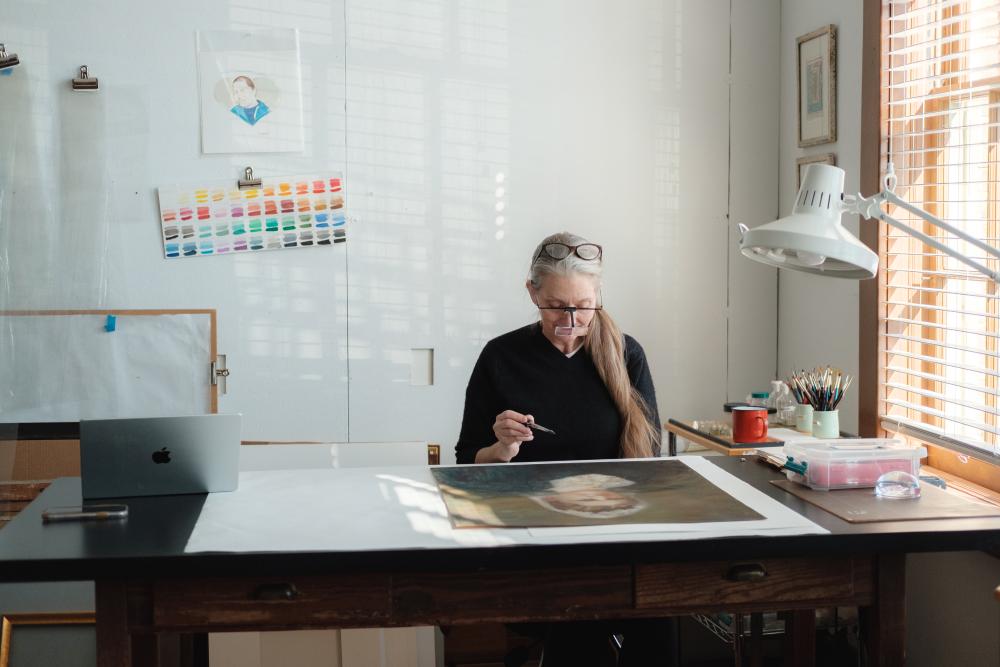
A paper conservator by trade, Cowan restores historic documents, paintings, prints, maps and other paper items. Earlier this year, a fragile, aged canvas of Richmond’s iconic Hollywood Cemetery was spread across one of her studio tables waiting to be cleaned and restored.
In a city like Richmond, where history lingers around every corner, Cowan stays busy.
Bringing delicate bits of the past back to life is a painstaking, meticulous labor of love.
Not unlike the efforts of those who tended to Cowan during her weeks-long recovery.
Craig Sadler, M.D., assistant professor of surgery at the VCU School of Medicine, is a member of the acute care surgical services team who saw Cowan “within a minute” of arriving in the trauma bay that October day. He served as her primary doctor during her first week in the hospital and followed up throughout her recovery.
Her wounds were extensive. The breaks in her cervical spine required two surgeries. Cowan wore a neck brace for two months. She had a torn rotator cuff. Her skull was stapled from the front almost to the nape of her neck. The punctures and lacerations on her back and arms indicated that Cowan was in the fetal position for much of the attack. The sheer number of bites and deep lacerations took nurses nearly two hours to clean and pack her wounds.
Violent trauma – gunshot wounds, for example – are the norm for Dr. Sadler’s trauma bay.
A bear attack was something new.
Despite what she had been through, it wasn’t just the attack that made Cowan stand out among patients.
“One of things that was striking about her was just the optimism,” Dr. Sadler said. “Most of our patients are here because something really terrible happened to them on one of the worst days of their lives.”
“None of them have asked to be here,” he said, “and so we are very used to seeing patients having any manner of emotional reaction.”
Cowan was different. Even in her early recovery, she connected with those providing her care in a way that struck almost all of them.
“She was very warm, she said ‘thank you’ a lot,” he said. “Once she was stabilized, she was motivated to get better as quickly as possible to put this behind her.”
While in the hospital, Cowan realized that being attacked by a bear wasn’t an everyday occurrence. Her status as the “bear lady” afforded her a lot of attention from a lot of people.
The attention helped.
“The bear gave me a step up – I was the bear lady!” Cowan exclaimed. “It was such an unusual story and people were always stopping by and asking me about it. But that support meant so much and it helped me climb out of all of this and it helped me heal, physically and mentally.”
Cowan spent a month in the hospital, followed by a month of home care services and a year of physical therapy. She was so grateful to her care team. She also recognized that the attack had shifted something in her – and she wanted to channel that into something that helped others.
Months later, the “bear lady” would walk back through the doors of the Gateway entrance at VCU Medical Center, but with scars this time instead of gaping wounds, and a newfound determination to take all she’d seen and use it for good.
Giving Back
The Virginia-based Trauma Survivors Network is a national program established by the America Trauma Society to connect trauma survivors with a community of resources and support, as well as providing training and resources for healthcare providers.
As a member of that network, VCU Health offers a volunteer peer visitor program that pairs recovered trauma patients with current trauma patients, offering the kind of hope and understanding only another survivor can provide.
I just loved my VCU care team so much and I saw volunteering as a way to keep in touch with them.
Cowan recalled learning about the program several months after her hospital release. She hadn’t been introduced to it as a patient – she suspects that it was because, as the “bear lady,” she was already flooded with attention.
Cowan thought back to the roommate she met after leaving the intensive care unit. The woman had been shot in the stomach by a family member. Gunshots wounds were heartbreakingly routine.
Knowing how much support impacted her own recovery, Cowan saw an opportunity to be that support for others. Now as a volunteer with Trauma Survivors Network, she visits the trauma wing at VCU Health once or twice a month, often alongside fellow survivor Diana Eadie, who lost her leg in a motorcycle accident and was treated at VCU Health in 2017.
“I didn’t know what to expect,” Cowan said about her decision. Volunteers are sometimes asked to visit patients who’ve had similar experiences. But she wondered how many other bear attack victims there could be. (Answer: none, so far.) Animal attacks of any kind aren’t frequent.
“Sometimes it’s hard to connect with the patients because my trauma is so different from theirs,” she said. Sharing the experience with Eadie helps, particularly if there’s a lapse in conversation.
Being the “bear lady,” it seems, is the ultimate icebreaker.
“Diana will just say, ‘Wendy was attacked by a bear’ and that’s usually what gets them thinking about that and not themselves,” Cowan said. “Maybe I don’t connect with them and their injuries, but even if I can go into a room and help a patient take their mind off of their pain for a few minutes, that’s worth it.”
Eadie, who’s been a volunteer for seven years, described Cowan as empathetic and genuine.
“Wendy doesn’t know a stranger,” she said. “Even though most people can’t relate to a bear attack, they do relate to being out in nature and not knowing what’s going to happen and being hurt and not knowing what to do.”
Eadie said Cowan never hesitates when the call comes for peer visitors.
“I’m really thankful she sees it as something important,” she said. “We can help people understand that they do have a road to recovery.”
Cowan said volunteering has helped her healing process.
She carries a list with her during her volunteer rounds. On it she’s scribbled two rows of more than a dozen names, some full, some just initials.
They’re the people who restored her body and her soul.
The names represent all levels of her care. There are the nurseswho took the time to gingerly wash and brush Cowan’s matted, blood-soaked hair after her head wounds had been addressed. Cowan initially instructed them just to cut it. They never did.
There’s the nurse who brought her a toothbrush for the first time, and another who stayed well after her shift ended just to make sure Cowan’s pain medicine was working.
Unable to walk for a month, Cowan needed help bathing. She recalled how her nurses delightfully sang Outkast’s “So Fresh, so Clean” as they took care of her. Their names are on the list, too.
“I just loved my VCU care team so much and I saw volunteering as a way to keep in touch with them,” Cowan said. “One of the great things they did was make me really interested in what they were doing. They added a sense of wonder, which kills the disinterest you get when you’re in the hospital in this awful trauma situation.”
She wants them to know they’re appreciated.
“They go out of their way to make you comfortable, but it’s a hard job. A lot of patients are hurting and they’re just angry because there’s a tendency just to get stuck in this awfulness,” she said. “Seeing the doctors and the care team doing everything they can, it makes the world feel like a different place.”
“It makes me want to be more like them.”
For her efforts, Cowan this month received the Cole Sydnor Trauma Survivor Giving Back Award during the 17th annual VCU Health Trauma Center Shining Knight Gala. The yearly fundraising event honors dozens of Shining Knights, including EMS responders, trauma surgeons, specialists, nurses and more, celebrated for the part they played in saving a VCU trauma patient. Proceeds from the event support injury and violence prevention programs throughout VCU Health.
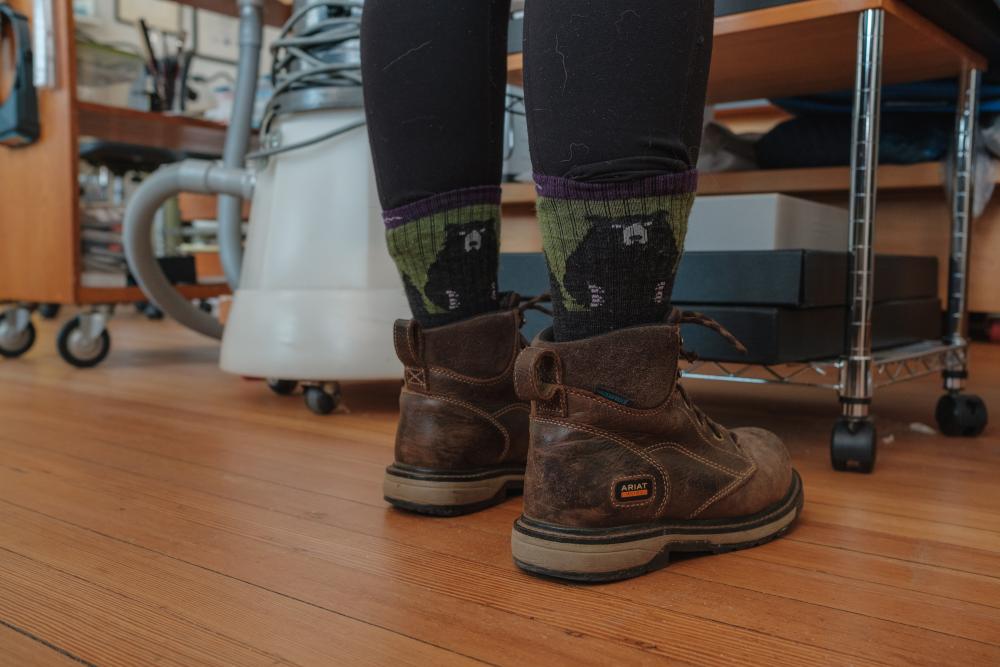
Cowan said she made peace with her attacker a long time ago. She calls her friends’ circle her bear club. Members received socks with bears on them.
“I’m not mad at the bear,” Cowan said. An avid hiker, it wasn’t the first bear she’d ever seen in the wild. “The bear had every right to be there just as much as I did. She was scared, and she wasn’t out to necessarily cause me harm.”
Volunteering puts life into perspective.
“Many people I’ve met are in so much more pain than I was or they’ve lost someone from their trauma,” Cowan said. “It makes me feel how lucky I am and I hope that talking to them, I can help them to feel better, at least momentarily.”
The reminders of what she survived will always be with her.
“I’ve got a ton of scars,” Cowan said, extending her arms to reveal faint marks. A slash on her face that barely missed her eye is nearly invisible unless she points it out.
“I don’t want them to go away,” she said softly. “I want to have them.”
Your generosity saves lives.
Support patient care, education and research on the MCV Campus.