The Simple Physics of Ann Steigleder
Love of science and learning leads to endowment bequest
Ann Steigleder, MCV School of Nursing, Class of 1948, has always looked at things a bit differently. She’s quick to point out that her thinking is well in line with that of Spock, the iconic character in the Star Trek television series. “That’s my idea of how you should live your life,” she says. “Logically.” Coincidentally, the popular 1960s series aired around the time of Ms. Steigleder’s efforts to change nursing education on the MCV Campus from rote learning to integrated critical thinking. “I want things to be logical. Human behavior is illogical to me,” she says. “Math is logical, geometry is logical. I do well in those things.”
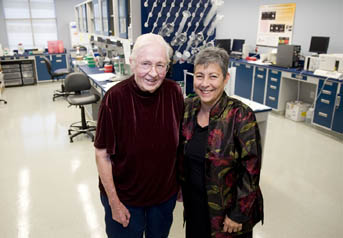 She is so attuned to the science of things she once pointed out to a medical intern that a patient’s drainage system had been set up incorrectly. He insisted that he had been taught to do it that way, only to be told by Ms. Steigleder, “Look, it’s just simple physics.” To everyone’s surprise but hers, she corrected the mistake. “What girl back in the ‘40s and ‘50s knows about physics?” she laughs.
Ann Steigleder knows about physics. Her dream was to become an engineer, but she was steered into nursing by her parents, receiving her diploma in nursing from MCV and both her B.S.N. and M.S.N. from Western Reserve College, now Case Western University, in Cleveland, Ohio. Whether her scientific interests stemmed from her father, a building contractor who relocated the family to Hawaii to put in piers at Pearl Harbor during the depression, or from her own natural abilities, she recognized early on that her strengths were atypical of young ladies of her era. “I was good in math, I was not good at the social side of things,” she remembers.
Ms. Steigleder readily admits that her campus-wide reputation, first as a nursing diploma student in the 1940s, then as a surgical nursing instructor at the School of Nursing from 1955 to 1965, was less than stellar on the social side. “I was going to infect every student I could get a hold of and turn them into logical thinkers and they were going to learn to think for themselves.” It wasn’t until later, during the tenure of Dean Doris Yingling that a graduate program for nurses, the first in Virginia, and the first formal research office in a school of nursing were both established on the MCV Campus. Clearly, Ann Steigleder was forging new ground for future nurses, and for the future of nursing, at a time when procedure was everything and problem solving was left to the physicians.
Mrs. Phyllis Chickos Patrick, N ’61, said of Ms. Steigleder, “She was a giant among teachers. As a country girl from West Virginia, I was scared to death of her, but I always respected her. One time, Ms. Steigleder had us write a paper about a patient we had cared for in the hospital. After class the day we got our papers back, Ms. Steigleder asked to see me and she said ‘I had no idea you were that smart, that you put that much thought into your nursing. From now on I will always have students write about their nursing experiences.’ So, she questioned everything, even her own teaching methods.”
“Nurses follow doctors’ orders, but that’s not nursing,” Ms. Steigleder explains. “That’s not what nursing is. You carry out doctors’ orders intelligently; yes, you do that. It’s a cooperative relationship. But there has to be a body of knowledge that underlays nursing practice.” It was this body of knowledge she hoped to build — if not through changes in the educational system itself, then through the classes she taught. Her experience as an operating room nurse helped make the case for patient education, which took place rarely if at all. And she was perplexed by the illogical departmentalization of medical nursing and surgical nursing. “I wanted to teach medical surgical nursing [as one] and was told, ‘nobody can do that, they’re two different things.’” She was a frustrated medical futurist in a world where nursing students simply staffed hospitals in the name of clinical experience. Her idea was simple: teach nursing as part of a team-oriented integrated patient experience.
From advocating research and problem solving, to patient education and lifelong critical thinking, Ann Steigleder was a dedicated patient-centered nursing educator.
“Ann was actually way ahead of her time in efforts to assure that the scientific basis of nursing, or what we currently refer to as evidence-based practice and research, was the foundation for the curriculum and courses of the school,” says Nancy F. Langston, Ph.D., RN, FAAN, Dean and Professor for the VCU School of Nursing and Executive Director of Academic Nursing for the VCU Health System. “She expected students to engage in critical thinking and clinical reasoning in ways that are now being rediscovered.”
According to Mrs. Margaret Vaughn Harvey, N ‘62, “Everybody loved her. She didn’t do anything the conventional way. She had an unusual way of thinking. And she challenged us, encouraging us to ask questions and to think outside the box.” In fact, it was Ms. Steigleder who encouraged Miss Vaughn to take the project she developed for her senior leadership course to Miss Pottinger, the director of nursing at MCV Hospital at the time. As a result, she and seven others from the Class of 1962 were given the opportunity to run 3 South and West for two years using an interdisciplinary approach to nursing and health care. “It was my undergraduate experience at MCV and that project that led me to Boston University for a master’s degree in nursing with a focus on interdisciplinary treatment plans.”
Today, Ms. Steigleder spends the majority of her time in the sleepy Northern Neck community of Farnham, Virginia, where she tends to several ponds, thins out the woods on her property, and annually stays in touch with former classmates and colleagues. Though she no longer considers herself a nurse, she supports the VCU School of Nursing and has made a generous million-dollar bequest to establish the Steigleder Endowed Chair for Research. By working closely with Dr. Langston and the School of Nursing development staff, Ms. Steigleder has created a lasting legacy to the continued evolution of research-based nursing education.
“With Florence Nightingale as the acknowledged ‘mother’ of modern nursing, we might expect that research was embedded in the DNA of the discipline,” said Dr. Langston. “But that’s not the case. Full engagement in the conduct of research did not emerge for almost a century after Nightingale’s work. Once again, Ann has shown herself to be ahead of the curve and we are again very, very grateful. We are grateful for her forethought. And we are grateful for her generosity.”
Ms. Steigleder’s generosity today is just as sincere and heartfelt as her teaching was years ago. “Everything I have came from nursing,” she explains. “Nurses are the main caregivers and if they are well educated people, I know that the cost of healthcare can come down because I’ve seen it.” More importantly, she explains, good research draws good faculty and good students. “How do you know what to teach without the research?” Not only is that logical, it’s just good physics.”