Changing the Odds
Written by Caitlin Hanbury | Video by Will Rummel
Matt Britt didn’t realize he had a gambling addiction until he was in recovery for substance use disorder.
It started innocently enough: card games with his grandpa for pennies, small bets with coworkers after the end of a restaurant shift. Ways to unwind, pass the time, feel connected he told himself.
Then, it changed.
What started as lighthearted and social, shifted. Wagering through texts with a bookie. Online betting apps. Trying to double rent, then obsessively win back losses. Then passing bad checks. After an arrest, a court date and debts of more than $30,000, Britt got what he calls a “nudge from the judge” – the first moment of accountability he couldn’t ignore.
The real turning point came when he heard someone describe problem gambling in a recovery support training session, and it hit him hard. He recognized himself in every word and realized, for the first time, that gambling was its own addiction, one he had never named or addressed.
“Recovery didn’t ever start taking hold until I could start being honest with myself about what’s going on,” said Britt, who is now a problem gambling peer recovery specialist for the Virginia Partnership for Gaming and Health at the VCU College of Health Professions.
That moment gave him the clarity he needed to finally seek help – clarity he now brings to others in recovery and that guides his role in the college’s effort to address problem gambling through real-time support, guidance and research.
How gambling became a constant companion
Traditional forms of gambling have always posed risks, but the rise of online gambling has supercharged the speed and scale of harm.
Once states began legalizing online casinos and sports betting, access expanded rapidly. New Jersey’s 2013 launch of online gambling showed what was possible, and a 2018 U.S. Supreme Court ruling opened the door for nationwide sports betting. Within a few years, gambling moved onto mobile apps and into the hands of anyone with a smartphone.
Today, a person can place a bet in the time it takes to unlock their phone. Micro‑bets turn every play of a game into a wager, and novelty and prediction markets let people bet on everything from celebrity breakups to elections.
Being able to have some sort of hope, you know, that this could be ok. And here’s how we do it, here’s the resources. To know that they’re not alone, because it’s scary to go through stuff like that alone.
Matt Britt
And even if you never go looking for it, gambling is part of the everyday media diet, from primetime sports broadcasts to major ad campaigns.
It’s an environment of perpetual access and risk.
“It’s everywhere and it’s all places. Does that mean more people are gambling? Yes,” said Carolyn Hawley, Ph.D., professor in the Department of Rehabilitation Counseling in the VCU College of Health Professions and the executive director of the Virginia Partnership for Gaming and Health (VPGH), the statewide treatment and workforce network for problem gambling in Virginia. “When you look at all the trends, you’re hearing month by month, year by year, increases in the amount of dollars people are wagering and the number of people that are gambling.”
The result is a problem growing faster than the systems built to manage its fallout.
Recovery within reach
Problem gambling has long carried the stigma of a moral failing. Science, however, tells a very different story: gambling disorder is a behavioral health condition rooted in the same neural pathways involved in substance use disorder.
“We want to change that perception, and let people know that gambling disorder is a behavioral addiction,” said Dr. Hawley.
People struggling with gambling harm often carry a constellation of overlapping conditions – depression, anxiety, substance use disorders – factors that can amplify the damage, making intervention critical.
“With increased access and availability of gambling, we’re also seeing more people develop harm because of their gambling,” said Dr. Hawley. “Long before somebody meets the criteria of gambling disorder, what we find is that gambling is having a negative impact. There are financial issues. There’s relationship conflict. They’re not showing up for school or work. There are mental health problems.”
Funded by the Virginia Department of Behavioral Health and Developmental Services and housed in the VCU College of Health Professions, the VPGH provides a rapid response that connects people with help. A call to the Virginia helpline leads to a peer‑recovery counselor with firsthand experience of gambling harm, a screening for services, and coordinated care with ongoing support. The goal is simple: meet people the moment they reach out and keep them connected to care.
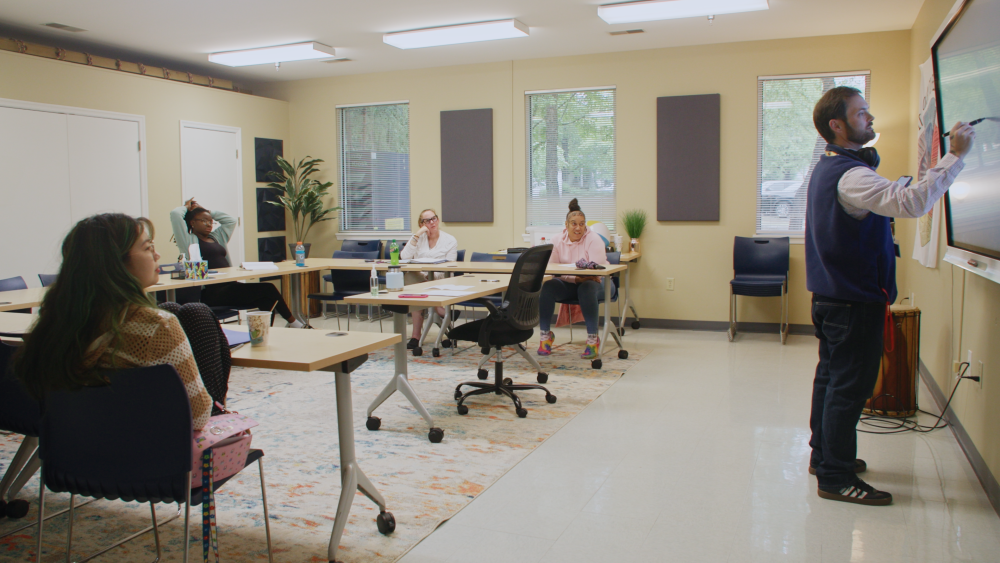
“We’re able to get 93% of individuals into services within one week of contact,” explained Dr. Hawley. “And that really matters because having that rapid response is important, particularly when we’re talking about addiction, because that one time that person picks up the phone and reaches out for help may be the only time they are willing do it.”
Stigma keeps people quiet, and the chance to help can be brief. In that moment, a peer recovery specialist steps in with one thing that most callers are seeking: hope from someone who listens without judgment – because they’ve been there too.
“Being able to have some sort of hope, you know, that this could be ok. And here’s how we do it, here’s the resources,” said Britt about his service as a peer recovery specialist. “To know that they’re not alone, because it’s scary to go through stuff like that alone.”
Built to grow
As the backbone of Virginia’s response to gambling harm, the VPGH’s home within the VCU College of Health Professions gives it a rare combination of strengths, including research capacity, clinical expertise and deep community partnerships. The VPGH team includes program leadership, faculty experts, clinical coordination staff, five on‑staff peer recovery specialists – one in each Virginia health region – supported by an external network of 25 peer recovery specialists and more than one hundred treatment providers.
“In our first year using peer recovery specialists, we’ve seen a 45% increase in the number of people going into treatment, and it’s grown ever since,” said Dr. Hawley. “With this model, we are looking at a system where everyone gets quality care. It doesn’t matter if you’re in Southwest Virginia or if you’re in Northern Virginia, if you’re a Virginian, you’re going to contact us and be able to get that same rapid level of support.”
Faculty bring expertise in behavioral health and counseling. Clinicians are trained to address the complexities that often accompany gambling harm. Peer specialists provide resources, support and guidance. Partnerships span the state.
Dr. Hawley and her team are leading some of the most powerful outreach across the state to address problem gambling. The college itself is uniquely positioned to house a Center for Problem Gambling because we are inherently interprofessional.
Amy Darragh, Ph.D., dean, VCU College of Health Professions
The infrastructure is here. So is the momentum. Creating a dedicated center is the next logical step.
The crisis that won’t wait
The Center for Problem Gambling will function as the nerve center to initiate research, clinical response and prevention under one banner to scale solutions and investigate the root causes of gambling harm.
“Dr. Hawley and her team are leading some of the most powerful outreach across the state to address problem gambling. The college itself is uniquely positioned to house a Center for Problem Gambling because we are inherently interprofessional,” said Amy Darragh, Ph.D., dean of the VCU College of Health Professions. “When we think about housing a center that is addressing something as complicated as problem gambling, we can think about the advantage of bringing all of the health professions to the table.”
The gambling market continues to accelerate, while the public‑health response struggles to find its footing. In state after state, leaders recognize the urgency but lack a coordinated plan. Prevention, treatment and data rarely live under one roof, and fragmented efforts leave critical gaps in care.
The proposed center at VCU will serve as a statewide hub for research, treatment and prevention and as the continued home for Virginia’s rapid‑response support system for people seeking help. It will be a place where the rapidly shifting landscape of gambling harm can be measured, understood and addressed with the full force of interdisciplinary expertise.

As Virginia’s public research institution, VCU is uniquely positioned to fill that need: its model demonstrates what a functioning statewide system can look like. Creating a dedicated center would strengthen that foundation by adding the ability to track what’s happening, understand it in real time and guide the response as the landscape continues to shift.
“We are thinking about what is next. What is the next horizon in problem gambling and all the aspects of life that it touches,” Dr. Darragh said. “We identify that by talking to communities, to individuals, by listening to stories, by trying to understand the lived experience that we’re serving. We also listen to the scientists, the researchers, the academics who are taking deep dives into solving problems.”
The center will also guide organizations looking to build their own systems and grow the workforce behind them, from training VCU students and clinicians to expanding telehealth and supporting peer‑recovery teams. Already, the work is drawing attention beyond Virginia, with other states reaching out to understand how it works and how it might be implemented elsewhere.
“Other states are seeing things that we’re doing and hearing about the successes that we’re having, calling regularly and asking ‘How do we help integrate this type of program into our services?’” said Dr. Hawley. “Well, we’re here to help.”
The future front and center
The vision is ambitious: a future that builds on a system already in motion – one where every Virginian knows where to turn for help and finds support ready to respond. A future built on trained clinicians, informed communities and research. And a future where new capacity – a dedicated center designed to measure, guide and strengthen the response – keeps pace with a rapidly changing gambling landscape.
The proposed Center for Problem Gambling at VCU aims to make that possible.
“Until we start treating gambling addiction like every other addiction on that scale, it’s just not going to get better. It’s impossible for it to get better,” Britt said.
The odds may be changing. But so is the response.
If you would like to support the VCU College of Health Professions, contact Greg Prince, Ed.D., the school’s senior director of development, at 804-920-8918 or tgprince@vcu.edu.