Engineering Access: How Medicines for All Is Making Lifesaving Drugs Affordable
Story by Caitlin Hanbury | Video by Tyler Trumbo
A drug that could end a pandemic only matters if everyone who needs it can actually afford to get it. In public health, this is known as the “last mile,” the critical final step in delivering health innovations to the communities that need them most.
That challenge lies at the heart of Medicines for All (M4All), a Richmond-based research institute reengineering drug manufacturing processes to make essential medicines easier and less costly to produce. Founded at Virginia Commonwealth University in 2017 with support from the Gates Foundation, the institute has become, among other things, a vital leader in the fight against HIV.
Most recently, M4All is advancing one of the biggest breakthroughs in the decades‑long pursuit of HIV prevention, making lenacapavir—a long‑acting injectable drug that prevents infection with 99% effectiveness—affordable and accessible in low‑ and middle‑income countries, while serving as the indispensable last‑mile partner the world relies on to design open, freely accessible manufacturing playbooks that turn high‑impact science into equitable, affordable supply.
We are here not only to save the cost. We are here to do something to save people's life.
Li-Mei, Jin, Ph.D., associate director of process development, M4All
Developed by U.S.-based biopharmaceutical company Gilead Sciences Inc., lenacapavir achieves its high effectiveness for HIV prevention with just two shots per year. Another injectable option is also available, but it requires more frequent dosing. Pre-exposure prophylaxis (PrEP) for HIV prevention has largely relied on daily pills, which could provide strong protection if taken consistently. However, the hurdles and responsibilities of daily living, coupled with the social stigma surrounding HIV prevention, can inhibit consistent use, reducing the drug’s effectiveness.
Lenacapavir changes that.
Unlike daily oral PrEP pills, which depend on strict adherence, this long-acting injection works for six months at a time. It’s an engineering triumph at the molecular level and a logistical victory for public health.
Yet such potential means little if the price is out of reach.
A coordinated global effort
The branded version of lenacapavir for HIV prevention was initially priced for the U.S. market at around $28,218 per person per year, putting it beyond the reach of countries hardest hit by the HIV pandemic. But in the span of just one year, a series of coordinated global efforts by governments, health funders, research institutes, and pharmaceutical partners has transformed lenacapavir from a promising innovation into an affordable HIV prevention option for millions.
In 2024 the drug’s innovator, Gilead Sciences Inc., led efforts to expand access to lenacapavir by licensing six generic manufacturers to produce and distribute the drug in low- and middle-income countries, while pledging to supply it at cost and optimizing the manufacturing processes their facilities can deliver. The following year, global donors helped turn these plans into reality by funding large-scale purchases and supporting M4All’s ongoing work to further reduce the cost of the generic version’s complex active ingredient.
This effort is being driven by a broad coalition of partners including the Gates Foundation, the Global Fund, the President’s Emergency Plan for AIDS Relief, the Children’s Investment Fund Foundation, Clinton Health Access Initiative, Inc., Unitaid, Wits Reproductive Health and HIV Institute and the World Health Organization working together to make lenacapavir available to low- and middle-income countries at about $40 per patient per year.
M4All’s new low-cost process builds on these efforts, demonstrating production efficiency that can reduce prices and remove access barriers, ensuring lenacapavir’s promise can be realized worldwide.
“We are here not only to save the cost. We are here to do something to save people's life,” said Li-Mei Jin, Ph.D., associate director of process development at M4All who led the project in its early stages.
How Medicines for All began
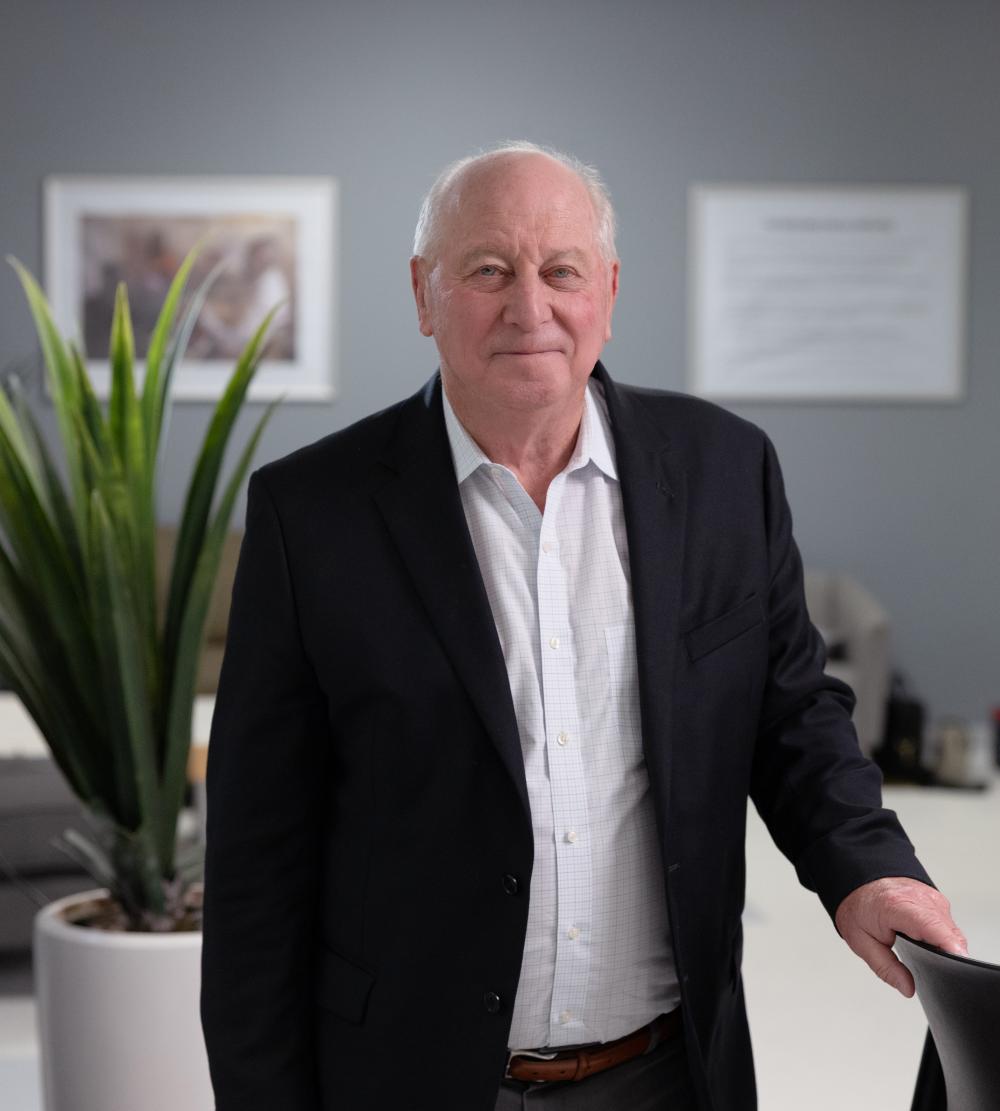
M4All was founded by Frank Gupton, Ph.D., a chemical engineer who spent three decades in industry developing and commercializing chemical processes for pharmaceuticals and agriculture. Over his career, he saw how drug production, from waste to labor to inefficient batch processes, drove up prices. Determined to do things differently, he returned to his alma mater, VCU, for a second career in academia to focus on one of the industry’s toughest challenges: the high cost of making medicines. Here, he’s built a team of scientists devoted to rethinking how medicines are made, making cost and efficiency central to every step of the process.
“What we're trying to do here is increase access to essential medicines around the world. And we've been fortunate because one of the most important things you can do when you're doing research and development is to identify a good problem to work on,” Dr. Gupton said. “So, once that problem is identified and we provide the solutions, all centered around ensuring that we're able to provide access to these drugs in ways that haven't been done in the past.”
The institute’s forty-person team includes process and analytical chemists, engineers, facilities administrators and safety experts. Together, they work to redesign the synthetic routes that produce the world’s essential drugs, finding ways to make established recipes for lifesaving medicines with fewer steps, less waste, and no compromise on quality.
Scaling the science
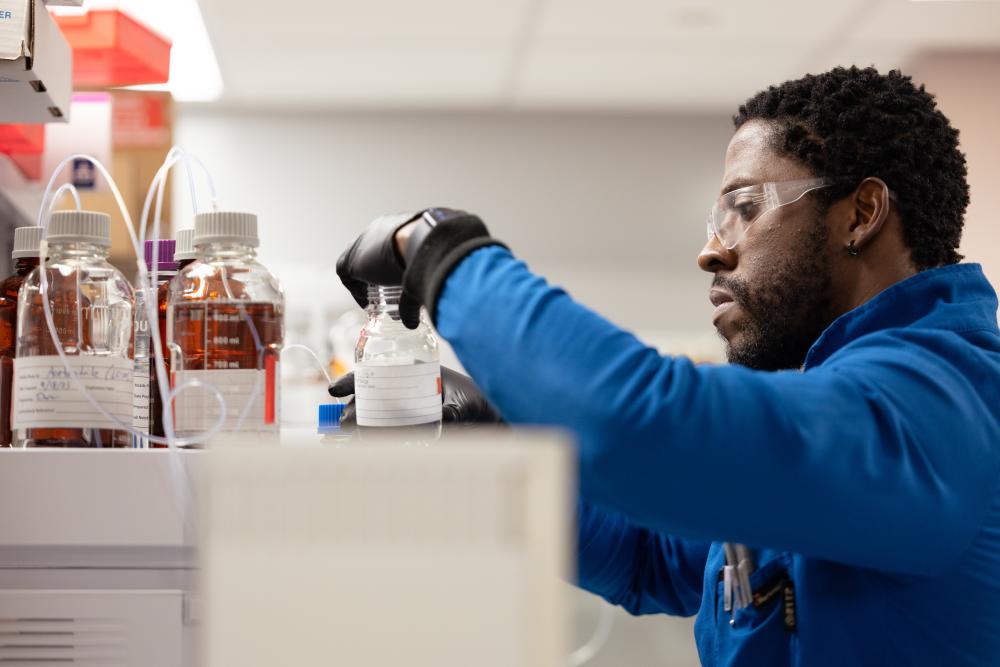
M4All’s work starts on gram scales, in glass beakers no bigger than a coffee mug, using the synthesis route developed by the drug’s original manufacturer—the established step-by-step process that combines chemicals in a certain order, under specific conditions, to produce the final medicine. Their chemists explore more affordable ingredients, tweak reaction steps, fine-tune conditions aimed at boosting yields and look for opportunities in the process to reduce byproduct waste, which can be both harmful and expensive to dispose of safely.
The institute’s efforts to improve the way essential medicines are made have markedly improved patient access, driving steep reductions in retail manufacturing of COVID-19 drugs and tuberculosis treatments.
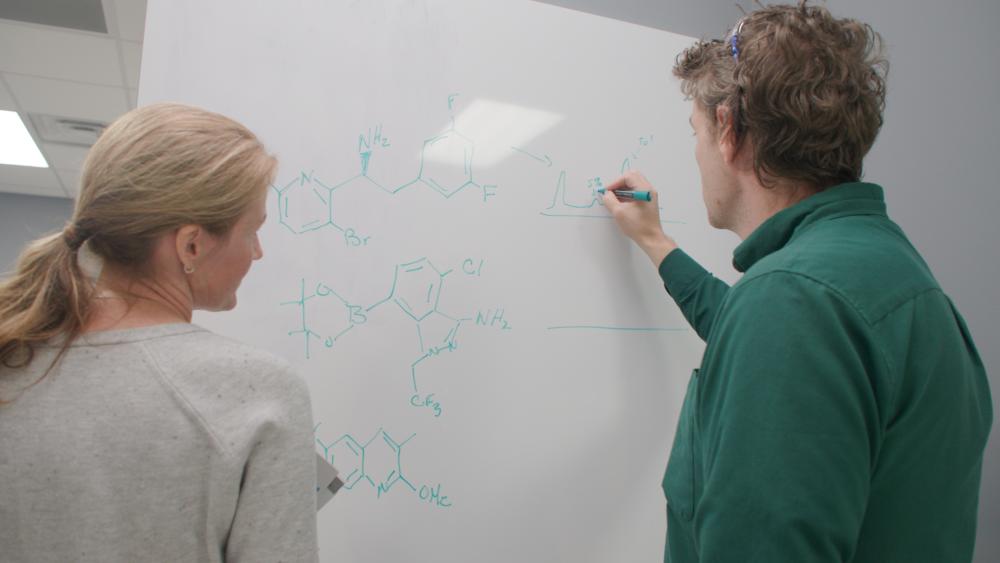
Work on lenacapavir began with chemists analyzing the three main core fragments of the molecule, known as fragments A, B, and C, and exploring how to make each from the ground up, taking cost and raw materials into account.
“This is the most complicated molecule I've ever worked on in my entire life,” Gupton explained. “We took the molecule apart, and we confirmed that we knew what the starting materials were. And then we figured out how to make each one of those starting materials more cost effectively. And we spent the first year doing that. And each one of these starting materials is probably equivalent in complexity to any drug that's out there. I mean, this is a beast of a molecule.”
This detailed, fragment-by-fragment analysis led to success. By redesigning the synthesis and refining each step for efficiency, the M4All team laid the groundwork for a process that is more efficient and more affordable.
Once the chemistry performs reliably in those few grams, scientists turn to scaling up, making sure a process that fits on a lab bench can run just as reliably on a manufacturing line anywhere in the world. As the work advanced, the results became clear—their new process reduced the raw material cost by about one-third.
“What we're basically seeing is somewhere around a 30% reduction in overall costs from raw materials inputs,” Gupton said. “Part of it comes from the key building blocks that we started out working on. Assembling these represented about 80% of the steps to make the medicine. And then part of it comes from the strategy that we used to assemble those key building blocks into the active ingredient. We've got a lot of really smart people, and they've looked at these processes differently than maybe a big pharma company would.”
From process to impact
Building on four decades of HIV drug innovation, from the first antiretrovirals in the 1980s to once-daily PrEP pills in the 2010s, lenacapavir ushers in a new phase of long-acting, low-burden prevention. And M4All’s contribution ensures that innovation doesn’t stop at the lab bench but reaches the clinics and populations where prevention is most needed.
We want to give people the agency and autonomy to take charge of their lives.
Tishina Rasulallah, Ph.D., M.P.P., senior manager for partnerships in global health, M4All
Inside M4All’s laboratories, the work appears deceptively simple: pipettes ferrying liquids into vials, magnetic stir bars spinning in flasks, scientists recording precise measurements. Behind these unassuming routines is a push to rework the mechanics of drug manufacturing so affordability stands on equal footing with efficiency.
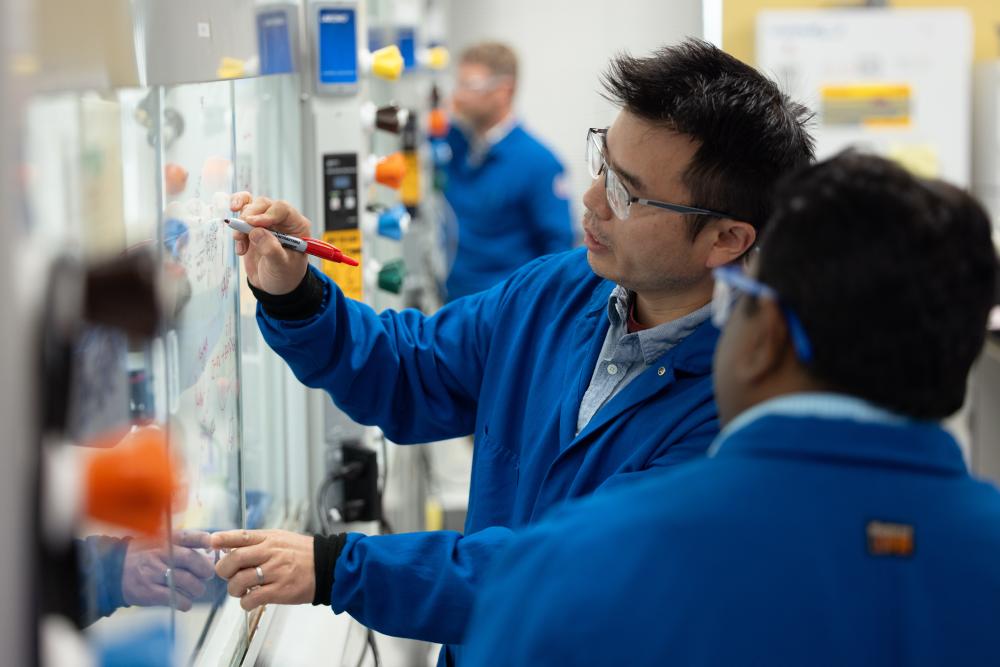
Of course, developing lower-cost, more efficient, and access-driven chemistry is only the first step.
“For so long, the knowledge and the power have been concentrated in what we call the global North or Western countries,” said Tishina Rasulallah, Ph.D., M.P.P., senior manager for partnerships in global health at M4All. “There is so much potential I’ve seen firsthand in lower- and middle-income countries. We want to give people the agency and autonomy to take charge of their lives.”
By rethinking how lenacapavir’s components are combined, M4All lowered production costs while making manufacturing safer and more sustainable. Reduced chemical waste protects lab workers, lessens environmental impacts, and makes it feasible for more manufacturers in more locations to produce the drug safely and efficiently.
M4All has a hand in actively applying these improvements beyond the lab by advising prospective manufacturers and partnering global health organizations to ensure that process improvements reach the places and people where access is most critical.
“Being able to transfer that knowledge that Medicines for All has developed for free to countries really can give them a leg up to be able to develop the drugs locally, to help build economies, to train people and scientists to be able to produce those drugs,” Rasulallah said. “And we don't know what other impacts it can have. In many ways, lenacapavir has become a case study for how upstream engineering decisions ripple through the entire global health ecosystem.”
Beyond one drug
M4All’s work on lenacapavir is part of a broader portfolio that also includes work on malaria treatments, tuberculosis drugs, hypertension medications, neglected tropical diseases, and pandemic-preparedness antivirals. Each project applies the same principle that better chemistry leads to better access.
It’s also changing how scientists and engineers approach their work.
“I think it's reshaping how people think about how we do things, what our processes look like,” said Justina Burns, Ph.D., associate director of analytical chemistry for M4All. “The accepted way, or the way it's always been done, is not necessarily what has to happen going forward. The change is possible.”
Virginia has taken notice. In 2023, the state committed $90 million to connect the University of Virginia Manning Institute for Biotechnology, Virginia Tech’s Fralin Biomedical Research Institute and the VCU Medicines for All Institute. The initiative not only speeds up biomedical research and strengthens drug supply chains, reducing the risk of shortages in the U.S., but also positions M4All at the forefront of Virginia’s effort to grow local manufacturing and attract new pharmaceutical investment.
Students—undergraduate, graduate and postdoctoral—play a role in this work, gaining firsthand experience in mission-driven biopharmaceutical innovation and learning to treat affordability as an engineering problem, not just a policy challenge. That combination of technical rigor and social purpose is what makes the institute unique.
The focus on mission over metrics drives how the institute approaches the challenge of access.
“We truly are here to do our mission,” Dr. Burns said. “We are what our mission statement says. We're here to help everybody find easier access to medicines, because nobody really should have to make the decision: can I afford my medicine?”
Make a Gift
Support access to essential medicines. Make a gift to VCU’s Medicines for All Institute.