
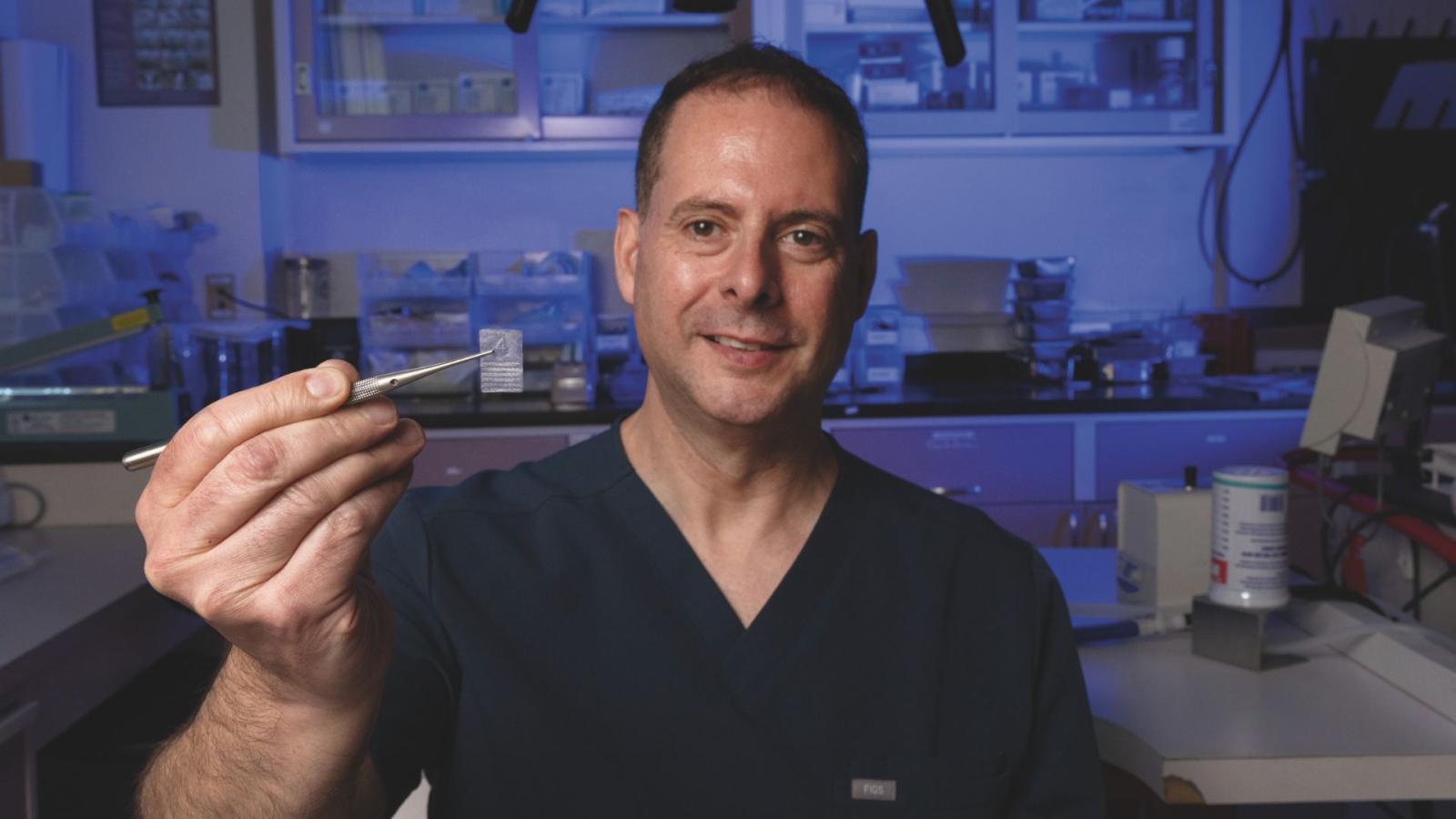
Jonathan Isaacs, M.D., the Herman M. and Vera H. Nachman Distinguished Research Professor at the VCU School of Medicine and chair of the Division of Hand Surgery at VCU Health, invented NerveTape, which has rapidly changed how clinicians approach complicated nerve repairs. Photo: Daniel Sangjib Min
Holding Fast: NerveTape
By Caitlin Hanbury
When a nerve is cut, the clock starts ticking.
Sensation and movement are lost immediately, and surgeons have only a limited window to reconnect the delicate fibers before movement and sensation are lost forever. For decades, the only option was painstaking microsuturing, a delicate process that tests even the most skilled and experienced surgeons.
That reality drove Jonathan Isaacs, M.D., VCU School of Medicine professor and chair of the Division of Hand Surgery at VCU Health, to invent NerveTape. The concept is elegant – microscopic hooks embedded in a flexible strip that latch onto each nerve end and draw them into precise alignment, providing mechanical repair strength equal to or greater than standard microsurgical suture repairs. Surgeons report that the tape creates a faster, more consistent repair process without altering the underlying biology of nerve regeneration.
Since its approval, NerveTape has moved rapidly into operating rooms across the country. It is now used in one-third of all Level I trauma centers in the United States, with 12,000 implantations to date. That trajectory, Dr. Isaacs said, has “scaled faster than the company would have predicted, and our overall success rate has been remarkable.”

After securing a licensing agreement with support from VCU TechTransfer and Ventures, Dr. Isaacs partnered with BioCircuit Technologies to bring NerveTape to market. BioCircuit describes NerveTape as “sticky,” referring not to the product’s microhooks but to surgeons’ behavior toward the device itself. Once a surgeon uses it, they tend to use it again. That high level of continued use is one of the strongest indicators that NerveTape is filling a real clinical need.
Nerve repair is one of the most technically demanding tasks in surgery. Traditional microsuturing is slow, delicate and difficult to perform, especially when precision determines whether a nerve will recover. NerveTape shortens the repair process while preserving alignment and strength, giving surgeons a simpler, more reliable way to handle a notoriously complex procedure.
Ultimately, our goal is to improve the surgeon experience and patient experience and outcomes.
Jonathan Isaacs, M.D., professor, VCU School of Medicine professor and chair, Division of Hand Surgery at VCU Health
In the two years since NerveTape’s commercialization, the scientific literature has begun to reflect what surgeons have been reporting. Clinical outcomes appear comparable to suturing, but surgeons consistently describe easier repairs completed in less time. One recently published paper highlights its use in breast reconstruction and neurotization – the process of connecting nerves to transplanted tissue to restore sensation. A forthcoming longitudinal study in animal specimens shows definitive improvements in nerve regeneration.
As the early evidence accumulates, a second story is coming into focus: NerveTape is gaining traction in procedures beyond those for which it was originally intended. Dr. Isaacs designed it for extremity nerve reconstruction, the standard technique of reconnecting two ends of a severed nerve so it can regrow. But surgeons have rapidly adopted it in breast neurotization, as noted.
“I never envisioned the rapid adoption of NerveTape in the breast neurotization market, which accounts for about half of sales of NerveTape,” Dr. Isaacs said.
Surgeons have continued to find new applications for NerveTape, sometimes through creative modification.
Cable grafting is one such example. When a nerve defect spans several millimeters, surgeons bridge the gap using an autograft, often a thin nerve from the foot or leg. Because these donor nerves are only 2 mm to 3 mm in width, multiple strands must be combined to match the diameter of the injured nerve.
Traditionally, each strand is individually sutured, a painstaking and time-consuming process. With NerveTape, surgeons can place the large nerve stump on the microhooks, lay individual graft strands onto the opposite side, and allow the hooks to self-assemble the strands into a unified cable graft. The time savings, surgeons report, is enormous.
Other teams are exploring additional possibilities, from using NerveTape to deliver targeted drugs that support nerve regeneration to adapting the platform for tendon repair and lymphatic-duct reconstruction.
Meanwhile, Dr. Isaacs is focused on how NerveTape can improve the repair of nerve gaps across different sizes. Backed by $4.5 million in funding from the U.S. Department of Defense, he is developing a longer version of the device that acts as a 10 mm to 15 mm conduit for bridging small gaps in nerves. He is also studying how NerveTape performs in larger 1 cm to 2 cm defects, where the tension across the nerve gap can make healing difficult. He is examining whether dissipating that tension across many small grab points could create a more stable environment for the nerve to heal.
Despite the rapid adoption of NerveTape, its early success and the new lines of investigation underway, Dr. Isaacs emphasizes that growth is not his primary objective.
“Just because we’ve had early success doesn’t mean we aren’t still looking at the device critically,” he said. “Ultimately, our goal is to improve the surgeon experience and patient experience and outcomes.”
This commitment to thoughtful innovation is one reason Dr. Isaacs received the inaugural VCU Annual Research Impact Award for excellence in research optimizing health – a recognition not only of NerveTape’s impact, but also of his deliberate approach to advancing a technology that is reshaping the future of nerve repair.