Leaving a Legacy
Alumnus’ gift reflects devotion, dedication to patient counseling program
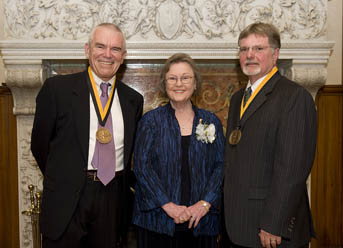 In January 2010, the Virginia Commonwealth University School of Allied Health Professions received its largest gift ever, a $1 million endowment from the Rev. Robert Lantz. The donation will fund a chair within the Program in Patient Counseling.
Katherine Lantz says that her husband, who died in 2008, hoped that the financial gift would provide stability and continuity to the program that so greatly influenced his professional life. She says that when her husband, a 1964 graduate, attended the Medical College of Virginia, “it was the richest educational experience of his career. And he wanted to provide that for others.”
As a young minister interested in pastoral counseling in 1963, the Rev. Lantz applied to three different schools to move further into his field. Ultimately, he selected MCV. “I have since never doubted that I selected the best of those three for my advanced training,” said the Rev. Lantz in 2003, when he was honored by the MCV Alumni Association of VCU as one of its Alumni Stars.
After receiving his certificate in patient counseling from MCV in 1964, the Rev. Lantz accepted a position as chairman of the Chaplain’s Department for the Baltimore City Hospitals. In subsequent years, he directed programs at the Memphis Institute of Medicine and Religion and taught pastoral counseling at St. Paul’s College in Washington, D.C., Memphis Theological Seminary, the University of the South at Sewanee and the University of Tennessee Medical Units School. In 1973, he founded the Maryland Institute of Pastoral Counseling Inc., and, three years later, relocated its operations to Annapolis, where he and his wife lived for 40 years.
D. Mark Cooper, D.Min., associate professor and chair of the VCU Program in Patient Counseling, studied under the Rev. Lantz as a student at Memphis Hospitals in 1968. Cooper describes this time as a “transforming experience.”
“Psychoanalysis was just starting to come into significance in the ’60s and in the church. Bob used the disciplines from Sigmund Freud, Carl Jung and John Dewey to look at people and the practice of ministry,” Cooper says. “That was exciting for a kid who was a son of a Lutheran pastor. I felt he was going to make a difference in people’s lives, and he did, and I wanted to be one of those people.”
The Rev. Lantz continued to serve as a mentor and adviser to Cooper throughout his education, which included training at VCU, and an early professional post as director of pastoral care at Washington Hospital.
Across his career, the Rev. Lantz also consulted with churches, seminaries and medical institutions, providing guidance in program planning, development and personnel management. In 1993, he brought his counsel to VCU as chair of the Pastoral Care Advisory Committee, which serves the Program in Patient Counseling.
Cecil B. Drain, Ph.D., dean of the VCU School of Allied Health Professions, says it took a genuine person such as the Rev. Lantz, who was extremely devoted to the department, to make it great. “The Rev. Lantz attended every advisory committee meeting and led each one strongly. It really made a difference,” Drain says. “He was a very good man, a great friend, a great alumni and a joy to be around.”
Drain, who became dean in 1997, says he learned about the profession of pastoral care through the Rev. Lantz’s mentorship when the two served on the search committee for a new chair for the Program in Patient Counseling.
“He became a valued friend and counselor,” Drain says. “He taught me a ton about the profession and what it was all about and what he felt it needed.”
High on the Rev. Lantz’s wish list was a Master of Science in Patient Counseling.
“We both agreed that students deserved more than just a certificate for their hard work over 18 months,” Drain says. “We specifically searched for a person who could develop and implement a new master’s program.”
They recruited Alexander F. Tartaglia, D.Min., now associate dean of the school, as the program’s third chair to lead the charge. “One of the things about Bob was he was determined,” Tartaglia recalls. “He believed when you have a vision, you go for it and don’t let anything deter you.”
In 1998, the program launched a comprehensive curriculum review, resulting in the long-awaited approval of the Master of Science in Patient Counseling in 2000. A year later, the program graduated its first students under the new degree.
Katherine Lantz says the university’s Program in Patient Counseling was always important to her husband. “He gave a lot of his time and energy to it, and when he became financially successful, he wanted to provide for the department’s continuity with a financial contribution,” she says.
In addition to serving as a skilled counselor, the Rev. Lantz was an astute businessman. He sold Kirby vacuum cleaners during his college career and did so well that when he graduated, he sold his business and invested in the stock market, becoming an expert on bank stocks across the years.
With his alma mater occupying such a meaningful place in his life for more than four decades, in 2001, the Rev. Lantz made an initial pledge of $100,000 to establish an endowed professorship for the Program in Patient Counseling. Before his death in July 2008, he planned a $1 million gift to upgrade the professorship to an endowed chair. In addition, a separate private foundation is being established to contribute to the pastoral care needs of Northern Neck residents and education of clergy in that community.
Gifts such as the Rev. Lantz’s remain vital to sustaining and enhancing the quality of programs within the School of Allied Health Professions.
“He wanted to give back to the institution but he also wanted to preserve it,” Cooper says. “This gift ensures that clinical pastoral education training will always be here.”