
Orphaned No More: Treating a Rare Blood Disease
By Holly Prestidge | Photos by Daniel Sangjib Min
A breakthrough clinical trial underway at VCU Massey Comprehensive Cancer Center could have global implications for the treatment of a rare blood disease often misdiagnosed because symptoms look like commonly known chronic skin conditions such as psoriasis or eczema.
Nearly a year ago, Massey became the first U.S.-based site to activate a global Phase 2a clinical trial for the treatment of cutaneous T-cell lymphoma (CTCL), a rare, slow-growing non-Hodgkin lymphoma that presents as itchy, scaly red rashes, plaques or lesions on the skin, typically on areas not exposed to the sun – the chest, groin, hips and buttocks.
Since Massey’s launch, several other U.S. sites have opened, along with sites in Australia and Europe.
There are more than 7,000 orphan diseases, which are classified as those that affect fewer than 200,000 people annually.
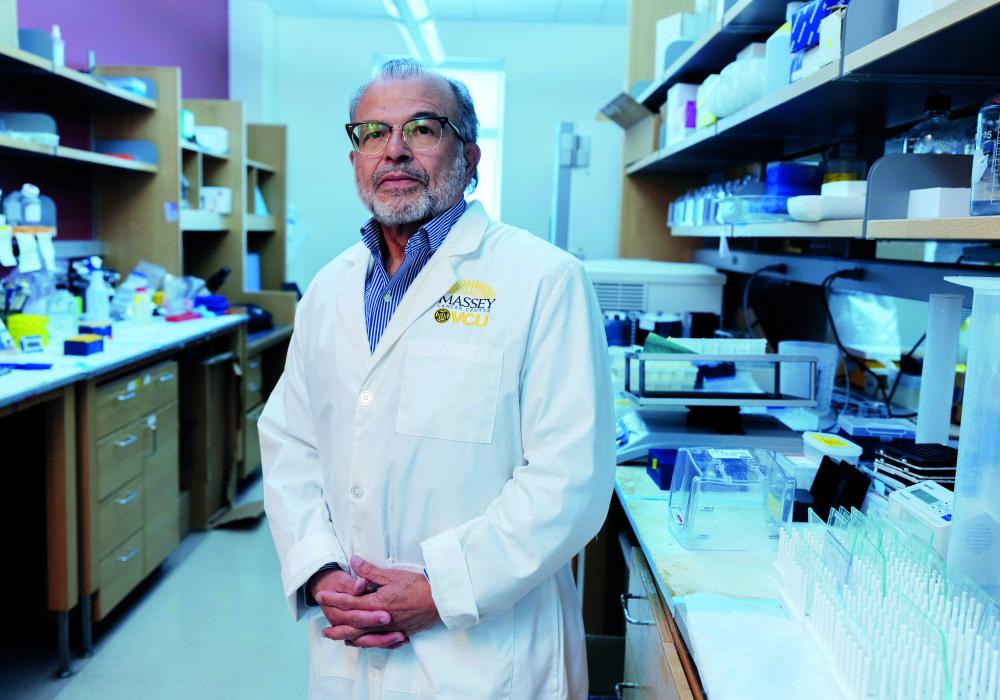
The therapy, called PTX-100, was co-developed by Saïd Sebti, Ph.D., Massey’s associate director for basic research and the Lacy Family Chair in Cancer Research, and a professor in the Department of Pharmacology and Toxicology at the VCU School of Medicine. He is the scientific founder of Prescient Therapeutics, which is sponsoring the trial.
CTCL occurs when white blood cells – part of the body’s germ-fighting immune system – become cancerous and attack the skin. The disease progresses slowly, and while there’s no cure, those diagnosed early, during stages I and II, have a more than 90% chance of a 10-year survival rate, often living with the disease for many years.
In advanced stages, however, particularly in stage IV, CTCL and its various subtypes can cause tumors or ulcers and attack lymph nodes, blood and internal organs. That median overall five-year survival rate drops significantly for those with stage IV CTCL.
PTX-100 effectively targets the cancer-promoting functions of certain proteins in cells. Within cancer biology, geranylgeranyltransferase type 1, or GGT-1, is a protein that is required for cancer-causing activity of proteins called GTPases.
The GGT-1 inhibitor therapy, developed by Dr. Sebti and colleagues, blocks these cancer-causing proteins from doing their job, which stops cancer growth.
“Our research focused on how certain proteins promote cancer within cells,” Dr. Sebti said. “With this novel PTX-100 drug, we are able to shut down the essential functions of GGT-1, intercepting signals that allow tumors to progress.”
Treating an Orphan Disease
Chances are most people have never heard of CTCL. The Cutaneous Lymphoma Foundation estimates annual diagnoses at roughly eight people out of 1 million in the U.S., and one in 10 million globally. Because of its low numbers relative to other cancers, it’s been designated as an orphan disease by the FDA. There are more than 7,000 orphan diseases, which are classified as those that affect fewer than 200,000 people annually. Pharmaceutical companies typically don’t pursue treatments for orphan diseases because the costs of research and development of therapies for such a limited population outweigh profits.
“The importance of treating orphan diseases cannot be understated,” Dr. Sebti said. “Every cancer researcher’s dream is to develop therapies that offer cancer patients better outcomes and make a difference in their lives,” he added. “What’s amazing is that, here at Massey, we are making great progress toward this goal.”
For Dr. Sebti and his colleagues, decades of research are paying off. Following successful Phase 1 human studies that showed PTX-100 was safe, they conducted a basket trial to test efficacy. Basket trials combine patients with different diseases that could respond to the therapy, to see which, if any, do.
We are dedicated to developing innovative drugs that have a profound impact on the lives of cancer patients.
Saïd Sebti, Ph.D., associate director for Basic Research Lacy Family Chair in Cancer Research, VCU Massey Comprehensive Cancer Center
In this case, patients with pancreatic and gastric cancers, multiple myeloma and T-cell lymphoma were treated. The best response came from patients with T-cell lymphoma.
The Phase 2a clinical trial has an immediate goal to treat 40 people, though ultimately the goal is to reach 115 people with CTCL.
Currently, Massey has two patients accrued to the trial. Many other CTCL patients have been accrued in the Australian sites, and more are anticipated to be accrued in other U.S. sites as well as European sites. Long-term remission and better symptom management are the goals. Patients with CTCL often respond to medications in early stages, then begin relapsing after three to four months when their skin conditions worsen.
Though the patient numbers within the Phase 1 clinical trial were very small, Dr. Sebti said that preliminary data indicates PTX-100 is safe and successfully shrunk or eliminated tumors in 40% of patients with advanced TCL who had already failed multiple previous therapies. For patients with CTCL, the drug kept the disease from worsening for a median of 13.6 months.
“These early results are impressive considering that current chemotherapy treatments for this aggressive cancer typically see tumors shrink in only 20% to 30% of patients, and usually stop the disease from worsening for just three to five months,” said Bruce Hough, M.D., Massey’s principal investigator of the Phase 2 clinical trial and assistant professor of Hematology/Oncology in the VCU School of Medicine.
“Our hope moving this into Phase 2a trial is that PTX-100 will significantly increase the percentage of CTCL patients who see their tumors shrunk or completely eliminated compared to what we expect from standard care,” Dr. Hough said.
He explained that patients with this aggressive cancer have faced limited treatment options and poor outcomes for a long time.
“By expanding this research, the team hopes that this novel therapy can keep the disease under control and from worsening for a much longer time period than traditional chemotherapy, giving these cancer patients better outcomes,” Dr. Hough said.
“This is big for Massey, but it’s even bigger for the community and for our patients,” Dr. Sebti said. “We are dedicated to developing innovative drugs that have a profound impact on the lives of cancer patients.”
Terms
CTCL: Cutaneous T-cell lymphoma, a slow-growing non-Hodgkin lymphoma.
GGT-1: Geranylgeranyltransferase type 1, a protein required for cancer-causing activity of proteins called GTPases.
PTX-100: GGT-1 inhibitor therapy that essentially shuts down the functions of this cancer-causing protein.
If you are interested in supporting Massey Comprehensive Cancer Center, please contact Jasmine Davis, executive director of development, at 804-828-1452 or jjdavis3@vcu.edu.
Stay Connected
Sign up to be inspired by stories of incredible innovation through our publication mailing list.